EU Regulation on Deforestation-free Products (EUDR)

Regulation 2023/1115: Compliance Guide for Deforestation-Free Products

What the EUDR Is and Why It Changes the Rules for Global Supply Chains

Regulation (EU) 2023/1115, as most recently amended by Regulation (EU) 2025/2650, governs the placing on the EU market, the making available on the market, and the export of commodities and products linked to deforestation. Its objective is to ensure that they do not contribute to deforestation, forest degradation, biodiversity loss, or greenhouse gas emissions.
Deforestation-free supply chains under the European Union Deforestation Regulation

EUDR Covered Commodities and Deforestation-Free Products

The EUDR applies to seven commodities and to the derived products listed in Annex I of the Regulation.
Mockup

Cocoa

Mockup

Coffee

Mockup

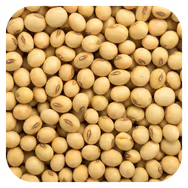
Soy

Mockup

Oil palm

Mockup

Rubber

Mockup

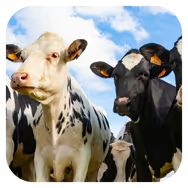
Cattle

Mockup

Wood

The Three Pillars of EUDR Compliance

Deforestation-free

Products must not originate from land deforested after 31 December 2020.

Legality

Compliance with the relevant legislation of the country of production.

Due diligence

Where required, submission of a due diligence statement including the geolocation data of the production plot.

When Regulation EU 2023/1115 Applies

The application dates vary depending on the size of the company, which must be determined with reference to the financial statements for the 2024 financial year. Although medium-sized enterprises fall within the definition of SMEs — up to 250 employees, €50 million in turnover, and €25 million in total assets — for operational obligations they follow the same deadlines as large companies.
Integration icon

Dicember 30, 2026

For medium-sized and large companies subject to EUDR obligations, the provisions apply after a 42-month transition period starting from the entry into force of the Regulation on 29 June 2023.
Integration icon

June 30, 2027

Micro and small companies subject to EUDR obligations, following the 48-month transition period from the entry into force of the Regulation on 29 June 2023.

EUDR Supply Chain Obligations by Role

The following scheme is based on the EUDR Supply Chain Infographics (3rd Edition) document.

Upstream operator

Exercises due diligence, submits a DDS in the Information System, assumes and maintains responsibility for compliance, keeps the relevant documentation, and informs the competent authorities. Where the upstream operator and the downstream operator are not the same entity, the upstream operator communicates the DDS reference number to the downstream operator.


Upstream micro or small primary operator (MSPO)

Exercises due diligence, submits a one-time simplified declaration, assumes and retains responsibility for compliance, communicates the declaration identifier downstream, and informs the competent authorities.

First downstream operator or trader (non-SME)

Does not exercise due diligence. Registers in the Information System, collects and keeps the required information, including DDS reference numbers or declaration identifiers, informs and verifies where needed.

First downstream operator or trader (SME)

Does not exercise due diligence. Collects and keeps the required information, including DDS reference numbers or declaration identifiers, and informs the competent authorities if information suggests product non-compliance.

Subsequent downstream operator or trader (non-SME)

Does not exercise due diligence. Registers in the Information System, collects and keeps basic information, and informs and verifies where required in case of substantiated concerns

Subsequent downstream operator or trader (SME)

Does not exercise due diligence. Collects and keeps basic information and informs the competent authorities if information suggests that relevant products may be at risk of non-compliance.

What Happens in Case of EUDR Non-Compliance?

In case of non-compliance, the EUDR requires Member States to provide for penalties that may include:

Financial penalties

Fines that are effective, proportionate and dissuasive; for legal persons, the maximum amount must be at least 4% of the total annual turnover generated in the EU.

Temporary market and export bans

Temporary prohibition from placing on the market, making available on the market, or exporting the relevant products.

Confiscation of products and revenues

Confiscation of the relevant products and the revenues obtained from the transaction.

Exclusion from public procurement and public funding

Temporary exclusion from public procurement and from access to public funding, including tenders, grants and concessions.
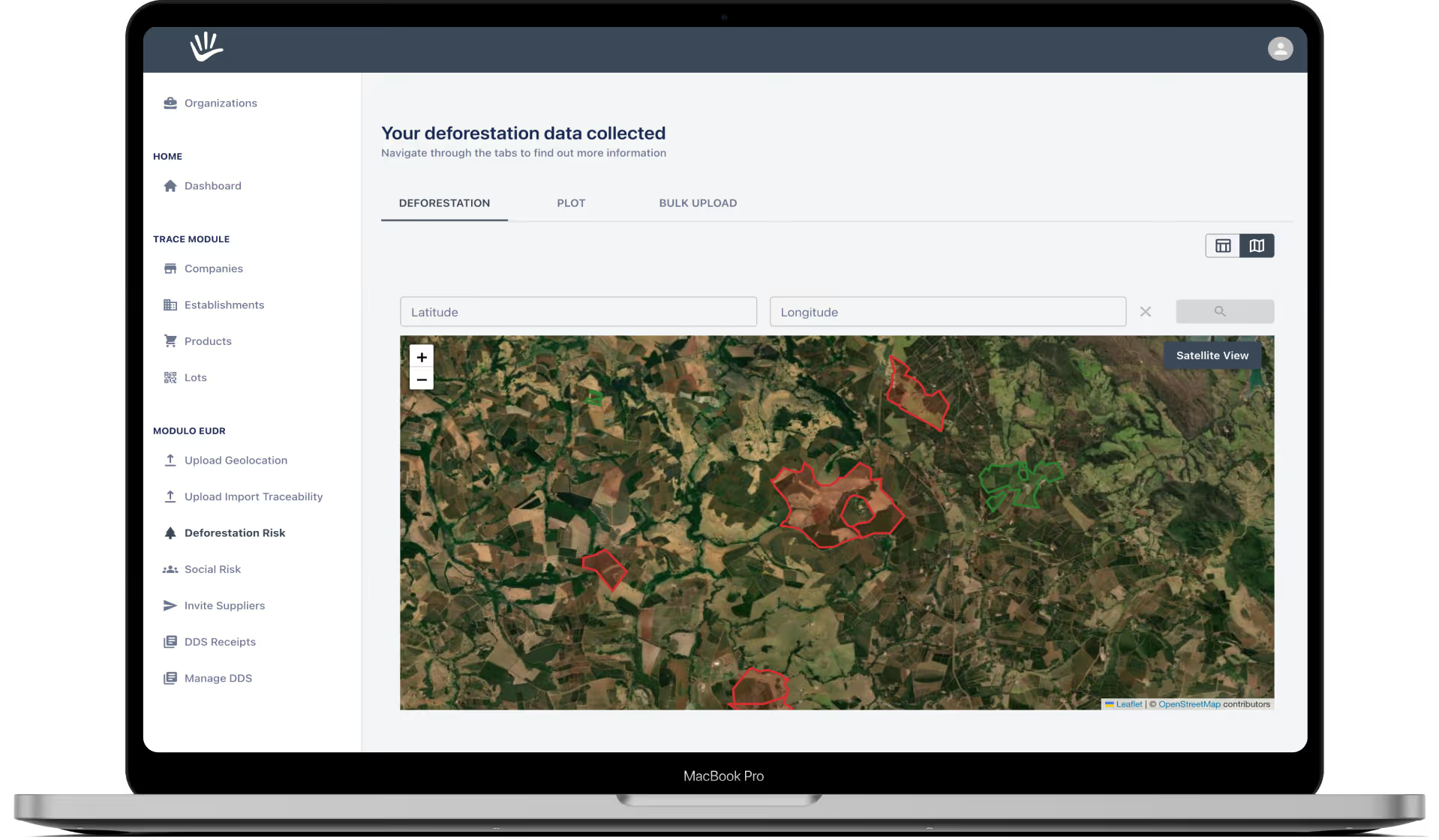
Dashboard mockup

Turn EUDR Compliance into a Competitive Advantage with Trusty

Trusty offers a robust, end-to-end traceability platform designed to ensure compliance with the European Union Deforestation Regulation (EUDR).
Online and offline data collection with seamless integrations
Validation and Real-time anomaly detection
Deforestation and social risk analysis
Due Diligence Management and integration with the EU TRACES NT portal
Dashboard mockup

Get Ready for EUDR Compliance with Trusty