2026 marks the definitive shift from environmental and social due diligence to measurable competitive advantage. Alessandro Chelli, CEO of Trusty, identifies three transformation drivers enabling companies to convert regulatory compliance into industrial, relational, and market value—reshaping how agro-industrial supply chains operate.
January 2026 – 2026 is emerging as the year when agro-industrial supply chains complete the transition from regulatory compliance to the construction of measurable competitive advantage. Environmental and social transparency, initially adopted in response to European regulations such as the EUDR, now becomes a strategic lever to strengthen market positioning, improve operational efficiency, and consolidate supply-chain relationships.
Alessandro Chelli, CEO of Trusty, an Italian benefit corporation using blockchain technology to ensure traceability in food and industrial supply chains and working with brands such as ICAM, Pellini, Sperlari, and Altromercato, outlines the dynamics and strategic shifts set to define the agro-industrial sectors in 2026.
.avif)
1. From EUDR compliance to “certified geographic transparency”
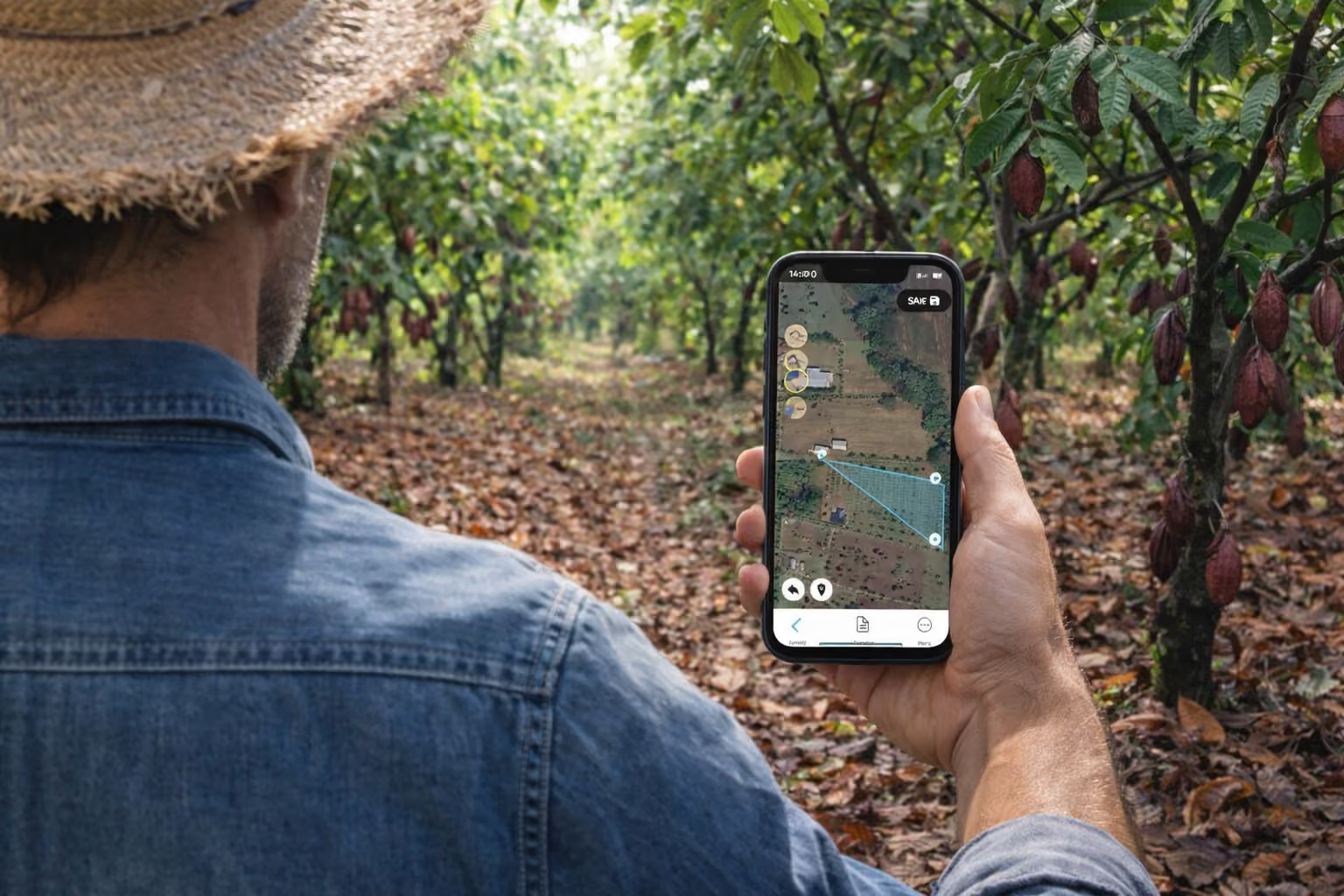
The European Deforestation Regulation has required companies to collect and manage geographic coordinates of production plots for raw materials. Over the course of 2026, this requirement will evolve from a documentary obligation into a strategic infrastructure. Validated and structured geographic data will become a reliable foundation for demonstrating supply-chain control, continuity of sourcing, and consistency with stated environmental commitments.
Information that once remained confined to due-diligence files is now being used to support industrial decisions, sourcing strategies, and market communication, strengthening product and brand credibility with consumers and large-scale retailers.
2. Expanding traceability: from the field to the social footprint
Regulatory pressure, initially focused on specific environmental risk factors, is evolving toward structured management of ESG data across the entire supply chain. In 2026, transparency will no longer be about isolated checks, but about a company’s ability to continuously collect, manage, and demonstrate reliable data on raw-material origins, production conditions, compliance with local regulations, and protection of involved communities.
The availability of structured, verifiable, and up-to-date information becomes the core element for proving operational control, reducing risk exposure, and supporting informed industrial decisions.
“In this context, traceability is no longer just about geographic origin, it becomes traceability of data and operating conditions. Companies will be required to collect, organize, and maintain verifiable information on agricultural practices, relationships with producers, local compliance, and issue management along the supply chain,” says Alessandro Chelli. “It will no longer be enough to declare compliance with certain standards. The social dimension becomes part of everyday supply-chain management, a structural factor for industrial reliability, risk reduction, and the strength of commercial relationships.”
3. Technology integration as a driver of efficiency and competitiveness
In high-volume sectors such as fisheries, manual data and control management is no longer sustainable. 2026 marks the consolidation of digital platforms and Software-as-a-Service solutions for supply-chain traceability and governance. These tools integrate systems, automate checks, reduce operational errors, and lower management costs.
Beyond meeting regulatory requirements, technology becomes a lever to improve overall industrial efficiency. In this context, artificial intelligence also begins to support data analysis, risk identification, and continuous process improvement.
“In 2026, agro-industrial supply chains will no longer ask only how to be compliant, but how to use geographic and social transparency to protect and strengthen their competitiveness. It is now clear that without traceability, the risk of exposure, loss of credibility, and restricted market access is extremely high. Transparency—from the field to the final product—becomes a non-negotiable operating condition. Integrating traceability data with EUDR and ESG data is the natural next step in building stronger, more efficient, and more credible supply chains. Companies that can turn due diligence into an operational and strategic asset will lead the next market cycle,” concludes Alessandro Chelli.
Want to implement 🖐 Trusty in your company? Contact us here.
Note. Some graphic elements and visual content on this page may include assets licensed from third-party platforms and/or content generated or reworked using artificial intelligence tools. These elements are used within the limits of the relevant licences and for illustrative purposes.