.jpg)
Limits of Origin Protection
The Agreement on Reciprocal Trade and Investment between the United States and Argentina has brought renewed attention to the issue of names considered generic in certain markets, highlighting the limits of origin protection outside the contexts where it is fully recognized.
Signed on February 5, 2026, the agreement does not enter into force upon signature alone: it will become effective 60 days after both countries complete their internal procedures. On the Argentine side, the parliamentary process remains decisive: as of March 19, 2026, the agreement is still awaiting approval by Congress.
In this context, a fundamental question becomes central again: how effective are origin protection tools when they operate outside their core jurisdiction?
DOP and IGP remain robust systems, built on strict specifications, structured controls, and a clear link between product, territory, and production method. However, their effectiveness also depends on the commercial environment in which they operate.
When in certain markets names such as “Parmigiano,” “Gorgonzola,” “Grana,” “Asiago,” “mortadella,” or “prosciutto” are treated as generic, that protection weakens precisely where it would matter most. This creates space for products that evoke Italy without sharing the same connection to territory, the same control systems, or the same Italian know-how.
If Origin Is Not Visible, Products Compete on Price
Anyone involved in exports knows this dynamic well: what is recognized and understood in Italy is often not abroad. Specifications, controls, territory, and Italian know-how may feel distant from the language of the market.
Buyers and importers think pragmatically. If a difference cannot be verified, it becomes debatable. And when it is debatable, it becomes negotiable.
This is why the issue is not only legal or commercial. If, on a shelf, the difference between an authentic product and one that merely borrows its name is not clearly visible, the conversation inevitably shifts to price.
Consumers see two similar products. Buyers see a positioning that is harder to defend. And Italian producers find themselves defending their value in a context where quality and origin are not immediately visible.

Italian Sounding and the Risk for Italian Products
This is where Italian Sounding becomes stronger: names, images, colors, and references that evoke Italy without corresponding to a truly Italian product.
The issue, therefore, is not just protecting a name. It is about making visible what that name stands for.
When authenticity and supply chain remain in the background, the reference to Italy risks carrying more weight than the actual substance of the product.
Why Protecting Product Value in Export Markets Matters
Many buyers are not simply asking where a product comes from. They are asking something more concrete:
How can I justify your price in my market?
What can I show my customers in a simple way?
How quickly can you provide evidence for a specific batch?
Do you have a system that reduces my risk?
Many negotiations are decided here. If proving origin, production steps, and controls requires long email exchanges, manual document collection, and slow response times, the fastest lever becomes discounting.
If, instead, information is clear, accessible, and verifiable, buyers have stronger tools to support the product’s positioning.
How Traceability Supports Sales, Not Just Compliance
This is where traceability changes role.
It is no longer just about quality or compliance. It becomes a sales support tool.
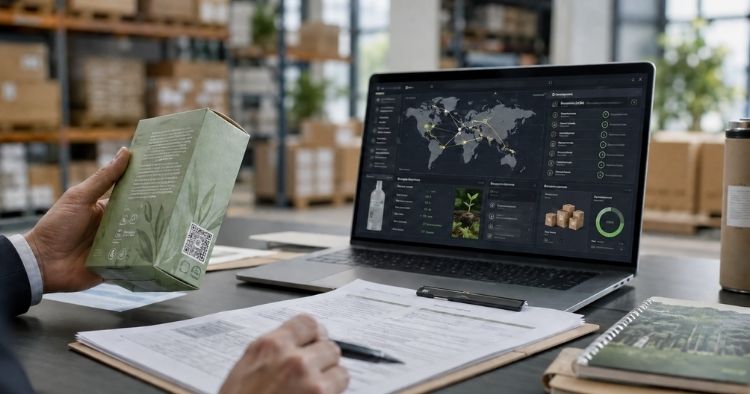
If a buyer can access, for example via a QR code, structured evidence on origin, production steps, timing, batches, and controls, the difference moves from a claim to a verifiable proof.
Traceability does not replace origin certifications. It strengthens them, by turning what is often implicit, territory, supply chain, verification processes, and Italian know-how, into information that is directly accessible, even in a commercial context.
How Trusty Uses Traceability to Strengthen Market Positioning
.png)
This is where Trusty’s approach comes into play.
With Trusty, the supply chain can be recorded on blockchain and made easily accessible, also through QR codes, with geospatial and time-based evidence linked to batches.
This reduces the time needed to respond to commercial requests, improves access to verifiable information, and increases the buyer’s ability to support the product’s positioning.
The point is not to rely on a QR code as a simple informational link. When a product is connected to reliable data on origin, transformation, and supply chain controls, its value no longer depends only on the strength of its name, but also on the ability to provide concrete proof.
TrackIT Blockchain by Agenzia ICE
In this direction also moves TrackIT blockchain by Agenzia ICE, an initiative designed to support exporting companies in making their product stories more transparent and verifiable in international markets.
Participation in the project is free of charge and open until April 30, 2026. Agenzia ICE covers the setup and standard blockchain traceability service costs for 18 months.
Trusty is a Solution Partner of the project.
For companies operating in export markets, this represents a concrete opportunity to integrate traceability into their commercial strategy, not only as a compliance tool, but as a way to strengthen credibility and support product value abroad.
To strengthen your supply chain with clearer and verifiable information:
👉 Join TrackIT blockchain by Agenzia ICE: https://www.ice.it/it/blockchain
👉 Or Contact us
Note. Some graphic elements and visual content on this page may include assets licensed from third-party platforms and/or content generated or reworked using artificial intelligence tools. These elements are used within the limits of the relevant licences and for illustrative purposes.