.avif)
On April 15th, 2026, the Italian Chamber of Deputies approved the bill "Sanctioning Provisions to Protect Italian Food Products", after it had already passed the Senate on November 26th, 2025.
The timing was also symbolic, as the approval came on National Made in Italy Day.
The bill strengthens protection for Italy’s agri-food sector, makes controls tougher, and targets conduct that harms products, businesses, and consumers. Its main focus is still sanctions, but it also has practical implications for how companies collect, organize, and prove supply chain information.
What the Agri-Food Protection Bill introduces
The bill creates new offences such as food fraud and the sale of food products with misleading signs, strengthens protection for protected designations and geographical indications, and also addresses agri-piracy. It broadens sanctions, ancillary penalties, and confiscation measures.
Alongside the criminal side, the bill also acts on the administrative side. It increases penalties related to consumer information, food naming, ingredient lists, and indication of country of origin or place of provenance. It also sets up a steering body to coordinate agri-food controls and define the operational control plan.
Traceability and the new regulatory context
A clarification is important here. This bill is not a general traceability law. Its core remains the strengthening of the sanctions framework. That said, the approved text does contain explicit references to food traceability.
Article 8 updates the sanctions regime for breaches of the obligations set out in Article 18 of Regulation (EC) No. 178/2002 on food traceability.
The text also touches the buffalo milk supply chain by creating a single register for the movement of buffalo milk and related products within the SIAN system. In the fisheries sector, it introduces a specific provision on breaches of labelling and traceability obligations.

When traceability goes beyond compliance
In this context, traceability is not just about controls or compliance. It can also become a way to make product value easier to understand, especially in markets where origin, production rules, controls, and Italian know-how are not as immediately recognised as they are in Italy.
In its analysis of DOP and IGP protection in foreign markets, Trusty points out that when a difference cannot be verified, it becomes easier to question. And when it can be questioned, it becomes easier to negotiate on price.
So the issue is not just protecting a name. It is making visible everything that name stands for, from the territory to the supply chain, from controls to production steps, all the way to data consistency. When this evidence is not easy to access, the reference to Italy can end up counting more than the substance of the product itself. When origin, lot numbers, and controls are supported by verifiable information, traceability also becomes a commercial lever.
Why this matters for businesses
For companies, the message is clear. As controls increase, sanctions become tougher, and attention grows around origin, designations, consumer information, and traceability, it is no longer enough to work well. Companies also need to prove it in a clear, consistent, and timely way.
This is why supply chain data management becomes so important. Information scattered across spreadsheets, inconsistent documents, separate archives, and manual processes makes internal organisation more fragile and makes it harder to respond quickly to inspections, commercial requests, and audits.
There is also another point worth noting. Traceability can become a risk management tool. When supply chain data is clear, connected, and easy to access, companies are better prepared to identify inconsistencies, reconstruct critical steps, isolate anomalies, and react faster in the event of disputes, disruptions, or non-compliance. In other words, a well-traced supply chain does not just improve transparency. It also strengthens a company’s ability to prevent, assess, and manage risk.
This is where a digital solution can turn an obligation into a competitive advantage. That is not something the bill explicitly requires, but it is a practical consequence of the more demanding framework the bill helps create.
The role of Trusty
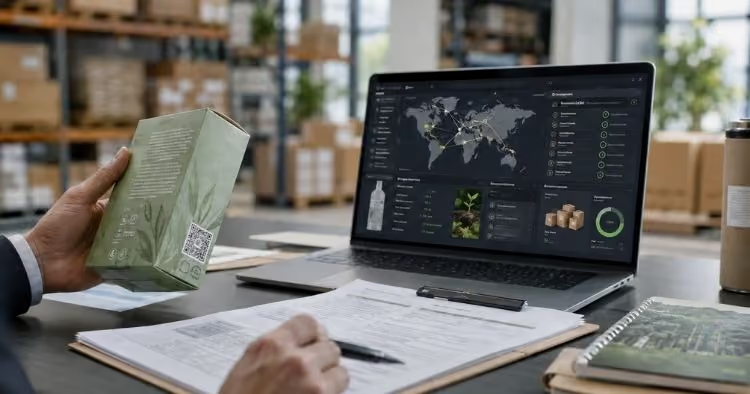
This is where Trusty can make a difference. Its blockchain-based traceability solutions help make supply chain information more robust and verifiable, giving companies not only greater transparency but also stronger support in managing risk. The QR code becomes a simple and immediate access point to this information, making it easier to consult data on origin, production steps, lot numbers, and controls.
.png)
In this way, traceability no longer stays confined to internal processes. It becomes a tool that gives concrete visibility to product value. And when that value is accessible, easy to read, and verifiable, it strengthens not only transparency but also brand credibility and a company’s ability to stand out in the market.
Choosing Trusty today means adopting an infrastructure designed for global markets, with automatic multilingual translation, to bring the real value of Made in Italy to international audiences in a direct and credible way.
TrackIT blockchain by the Italian Trade Agency
Another opportunity worth paying attention to is TrackIT blockchain by the Italian Trade Agency, an initiative designed for exporting companies to make the product story more transparent and verifiable in international markets. Trusty is a Solution Partner in the project.
For export-focused businesses, this can be a concrete opportunity to bring traceability into their commercial strategy and strengthen both product credibility and value abroad.
Want to implement 🖐 Trusty in your company? Contact us here
Note. Some graphic elements and visual content on this page may include assets licensed from third-party platforms and/or content generated or reworked using artificial intelligence tools. These elements are used within the limits of the relevant licences and for illustrative purposes.