From 30 December 2026, a shipment of coffee, cocoa or timber could be held at customs for a reason that has nothing to do with duties or VAT: the customs declaration is missing the EUDR TARIC code and the reference number of the due diligence statement. This is the practical effect of the EU Deforestation Regulation, Regulation (EU) 2023/1115 (EUDR), entering into application. For importers and exporters, EUDR compliance is now a customs matter.
Il Sole 24 Ore, Italy's leading business daily, recently covered the topic too (Focus, 29 October 2026), with an in-depth look at non-fiscal customs checks linked to the EUDR. It is a sign that the subject has moved out of sustainability teams and onto the desks of import-export managers. In this article we look at what changes for businesses: which products fall under the EUDR, which TARIC codes to use, the deadlines to meet and, above all, where compliance is actually built.
Customs and the EUDR: who checks what
nder the EUDR, customs also becomes a filter for environmental requirements. It checks that every in-scope product is covered by a due diligence statement (DDS) registered in the EU Information System. The legal basis is Article 26 of the Regulation, which governs checks on products entering and leaving the EU market.
Be careful not to confuse the roles, though. Assessing compliance on the merits is the job of the national competent authority: in Italy, the Ministry of Agriculture, Food Sovereignty and Forestry (MASAF). Customs acts as a checkpoint: if the reference is missing or wrong, the operation is blocked.
In other words, by the time goods reach the border, the compliance work must already be done. Customs does not ask you to prove anything at that moment: it asks for evidence that you already have.
EUDR products: what changes with Delegated Regulation (EU)2026/2102
There are still seven relevant commodities: cattle, cocoa, coffee, oil palm, rubber, soya and wood. But what actually falls under the EUDR is set out product by product in Annex I, through Combined Nomenclature (CN) codes. The trade name is not enough: classification is what counts.
The list has just changed. Delegated Regulation (EU) 2026/2102, adopted on 13 July 2026 and published in the Official Journal of the EU on 17 September, has been in force since 18 September 2026. We have followed its progress on our EUDR latest updates page.
An example makes this clearer: coffee beans follow the general timeline, while instant coffee comes into scope a year later. Companies that trade both have to manage two different regimes within the same catalogue.
EUDR TARIC codes: C716, C717 and exemptions
The link between the EUDR and customs runs through TARIC document codes. In its revision of 23 September 2026, the European Commission updated the technical document that describes them (source).
Other codes cover specific situations, such as re-imports, samples intended for analysis and used or recovered products. A missing or incorrect code can block the operation.
The key point is that the code is only the final label. Behind a C716 there is a DDS, and behind the DDS there is data collected in the field: plot coordinates, suppliers, batches, risk assessment.
Not sure which of your flows require a DDS? The Trusty team can help you find out and set up the data collection you need. Talk to us.

EUDR deadlines: when does the EUDR apply?
The current timeline comes from Regulation (EU) 2025/2650, which postponed the application of the EUDR and introduced some simplifications.
For most companies, that leaves about six weeks. It is not much, but it is enough if you start now: with Trusty's EUDR Compliance Solution, compliance can be achieved in one week. Request a demo.
From geolocation to DDS: where EUDR compliance begins
A valid DDS number is the last link in a chain that starts thousands of kilometres before the port:
- The product is classified and checked against Annex I.
- Suppliers are identified and, further upstream, the producers.
- Geolocation coordinates of the plots of origin are collected.
- Those coordinates are linked to the batches actually purchased.
- Risk is assessed and, where necessary, mitigated.
- The DDS is submitted and the reference number is obtained.
- The number goes into the customs declaration with code C716.
Problems almost always arise in steps 2 to 4. Small cocoa and coffee producers often lack digital tools. Mixed batches, intermediaries and paper documents break the link between plot and shipment at exactly the moment you need to prove it.
That is why the information must be requested and verified at the time of purchase, not when the goods are already in transit. And this is where a dedicated tool is needed.
EUDR Compliance Solution: Trusty's EUDR compliance software
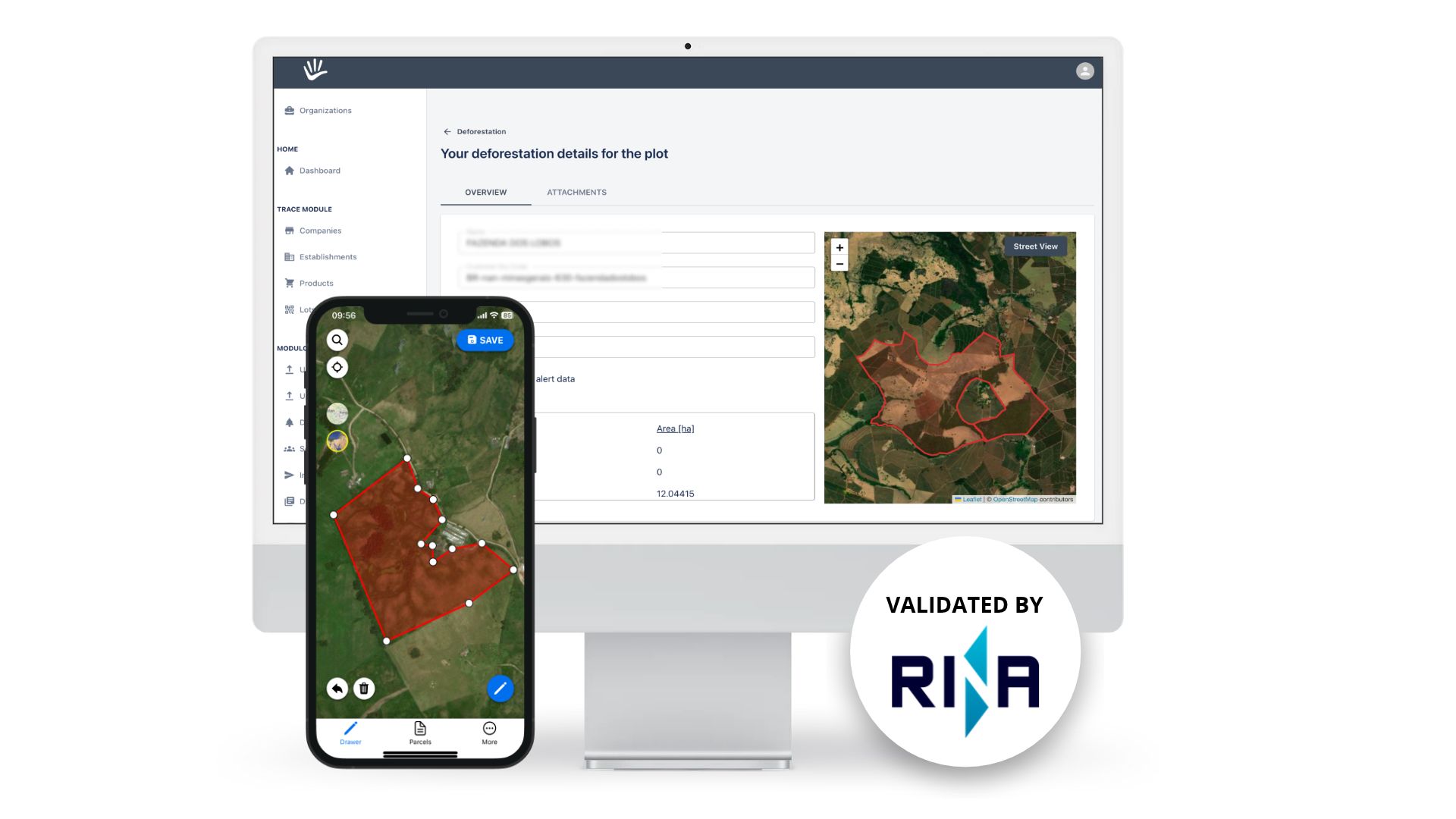
Trusty's EUDR Compliance Solution covers the entire chain, from field to DDS. It is validated by RINA, a multinational certification group operating in more than 70 countries, as a support tool for companies that must comply with EU Regulation 2023/1115. Trusty is among the first EUDR providers to be verified by a third-party body. In practice, the platform offers:
- Field coordinate collection. The EUDR Coordinates Collect app records plot points and polygons, even offline in remote areas, and exports them to GeoJSON.
- Supplier collaboration. Data and documents are collected directly on the platform with every actor in the supply chain; REST APIs connect company systems and eliminate manual steps.
- Automatic validation. Every uploaded file is checked for structure and consistency; if anomalies are found, the system alerts you in real time and suggests how to fix them.
- Risk analysis. Mapped areas are compared via satellite with forest and protected-area datasets, alongside the social and legal risk factors of the country of production.
- DDS submission. API integration with the EU Information System (TRACES) lets you submit due diligence statements and obtain the reference number to enter at customs.
The result: when goods arrive at customs, the DDS reference number is ready, backed by complete, consistent documentation ready for any checks by the competent authority. Request a demo and see how it works for your supply chain.
EUDR checklist: 5 things to do before 30 December 2026
- Recheck your catalogue against the updated Annex I. Delegated Regulation 2026/2102 removed and added products: a mapping done before September may no longer be valid.
- Clarify your role for each flow. Operators, downstream operators and traders have different obligations, and the same customs code may require different steps.
- Align your purchasing team and freight forwarder. Whoever completes the declaration must know which TARIC code to use and where the reference number comes from.
- Ask suppliers for geolocation data now. Write it into contracts and specifications; don't rely on last-minute requests. With the EUDR Coordinates Collect app, coordinates are collected directly in the field, even offline.
- Connect your data in a single system. Products, suppliers, batches, DDSs and customs declarations must talk to each other, so that commercial and customs data don't tell different stories. That is exactly what the EUDR Compliance Solution does.
Only a few weeks remain until 30 December. Discover the EUDR Compliance Solution or request a demo: we'll show you how to bring your supply chain into compliance, from data collected in the field all the way to the DDS.
Frequently asked questions about the EUDR at customs
What is TARIC code C716?
It is the document code to enter in the import or export customs declaration for EUDR products covered by a due diligence statement. The DDS reference number goes next to it.
When is code C717 used?
When the product is covered by the simplified declaration of a micro or small primary operator, provided for in Article 4a of the EUDR. It does not apply to just any small company.
When does the EUDR apply?
From 30 December 2026 for large and medium-sized companies and for micro and small companies already subject to the EUTR. From 30 June 2027 for other micro and small companies. From 30 December 2027 for products added by Delegated Regulation 2026/2102.
Are bovine leather and hides still subject to the EUDR?
No. Delegated Regulation (EU) 2026/2102 removed them from Annex I.
Who checks EUDR compliance?
Each Member State's national competent authority; in Italy, it is MASAF. Customs checks that the declaration shows the correct TARIC code and reference, and can block the operation if they are missing.
Is there software for EUDR compliance?
Yes. Trusty's EUDR Compliance Solution, validated by RINA, handles coordinate collection, risk analysis and DDS submission to the EU Information System on a single platform.
Sources
- Regulation (EU) 2023/1115 (EUDR), summary — EUR-Lex
- Delegated Regulation (EU) 2026/2102 — EUR-Lex
- EUDR Information System — European Commission
- EUDR TARIC document codes, revision of 23 September 2026 — Studio Padovan
- EUDR: latest updates — Trusty
Note. Some graphic elements and visual content on this page may include assets licensed from third-party platforms and/or content generated or reworked using artificial intelligence tools. These elements are used within the limits of the relevant licences and for illustrative purposes.