
Having Data Is No Longer Enough: Companies Need to Prove It
For years, many companies treated sustainability as something to communicate. Today, Europe is asking them to prove it.
Generic statements are no longer enough. Companies need reliable data linked to specific products, kept up to date and ready to be verified.
This is the common thread connecting the EUDR, the PPWR and the Green Claims Directive. These regulations cover different areas, but they all point in the same direction: compliance will depend not only on producing documents, but on the quality of supply chain data and the ability to use it to manage risk.
For companies in the consumer goods sector, and beyond, the challenge is not to collect more information. It is to make information usable. Supplier data, technical sheets, environmental claims and packaging information only create value when they are linked to the right product, supported by evidence and available when needed.
In this sense, the new rules act as a stress test. They show how ready a company is to respond to requests from customers, retailers or competent authorities. They also reveal where fragmented data management can lead to duplication, inconsistencies and delays.
Three Regulations, One Clear Direction
The EUDR, the PPWR and the Green Claims Directive cover different areas, but they all require companies to adopt the same shift in approach: moving from scattered information to verifiable data that is linked to products and ready to be used in case of checks, customer requests or market communication.
With the EUDR, Regulation (EU) 2023/1115, the focus is on specific commodities and derived products linked to deforestation risk, including cocoa, coffee, soy, oil palm, rubber, wood and cattle. Companies in scope will need to prove that their products are deforestation-free, compliant with the legislation of the country of production and covered by a due diligence statement. In practice, this makes data on origin, suppliers, geolocation of production areas, legality and deforestation risk essential. With Regulation (EU) 2025/2650, application has been postponed to 30 December 2026 for large and medium operators and to 30 June 2027 for micro and small operators.
With the PPWR, Regulation (EU) 2025/40, packaging is placed within a broader framework of responsibility across its life cycle. The regulation sets sustainability and labelling requirements for packaging, from production and use to waste management, and is generally applicable from 12 August 2026. A key point concerns the obligations of economic operators that manufacture, import, distribute or make packaging and packaged products available on the EU market. For companies, this means working not only on recyclability, reuse, recycled content and packaging information, but also on the ability to connect products, packaging, materials, suppliers, technical documentation and the responsibilities of the parties involved.
With the Green Claims Directive, Directive (EU) 2024/825, the same logic extends to environmental communication. The directive strengthens consumer protection against unfair commercial practices and misleading environmental information, commonly known as greenwashing; in Italy, it was transposed through Legislative Decree No. 30 of 20 February 2026. Environmental claims, sustainability labels and statements on future environmental performance will need to be based on stronger, clearer and more consistent evidence. For marketing, sustainability and quality teams, this means working from the same information base and avoiding claims that go beyond what can be proven.
Read together, these measures send a very clear message: having information is not enough. Companies must be able to connect it, update it, verify it and use it.
How a Data-Driven Supply Chain Changes
In many companies, the information already exists, but it is not always connected. Supplier records may be updated by Procurement, packaging technical sheets stored by Quality, environmental claims developed by Marketing and sustainability documents archived elsewhere. The risk lies precisely in this distance between data points.
To prepare for the new rules, the first step is not to produce another document. It is to understand where the information is today: who updates it, which product it refers to, what evidence supports it and which risks it helps identify or reduce.
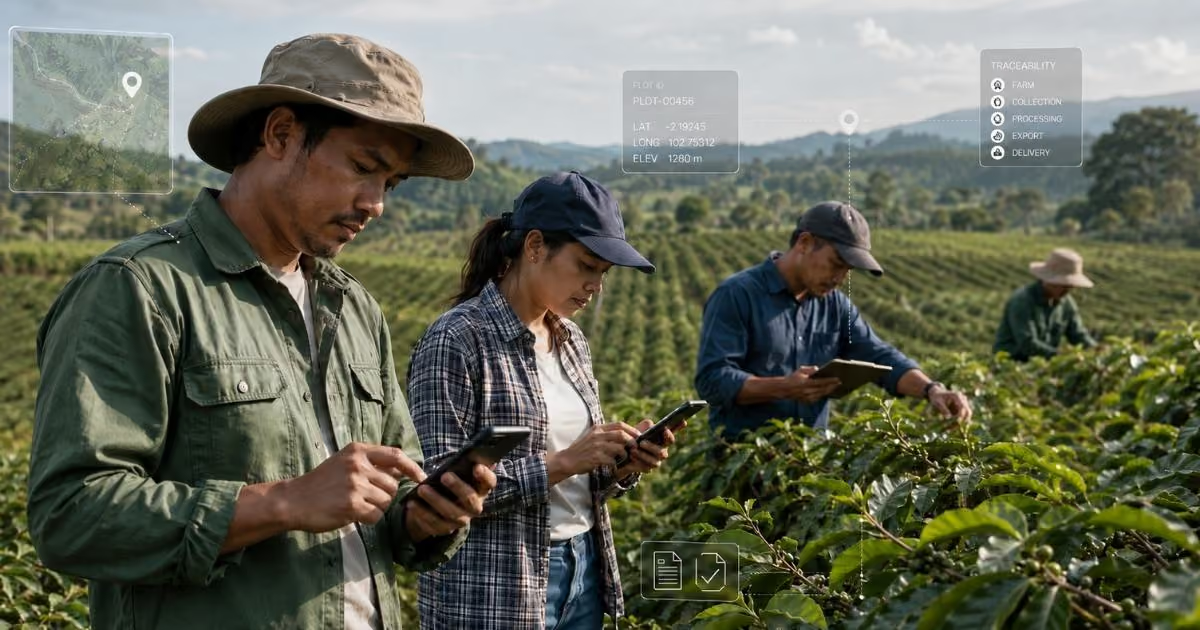
In a more structured supply chain, each product is connected to a consistent information base, where origin, suppliers, packaging, technical documentation, traceability data and environmental claims work together. For the EUDR, this means linking geographic coordinates, batches, suppliers and risk analysis. For the PPWR, it means connecting packaging, materials and the responsibilities of economic operators. For environmental communication, it means building claims on verified and up-to-date evidence.
The ideal supply chain is not free from complexity. It is a supply chain where data collected at the source becomes usable throughout the product journey: to respond to customers, prepare declarations, support audits, engage with retailers and communicate more credibly with the market.
Trusty: Modular Solutions to Turn Data into Value
This is where Trusty comes in. Specialised in agri-food and industrial supply chain traceability, Trusty supports companies in collecting, organising and sharing data across different operators, helping them turn scattered information into a stronger, verifiable and usable data base.
Trusty’s modular solutions are designed to meet a need shared by the new European regulations: making supply chain data more accessible, consistent and ready to support compliance, risk management and market communication. This applies to the EUDR, where companies need data on origin, geolocation, suppliers and deforestation risk; to the PPWR, where products, packaging, materials and the responsibilities of economic operators need to be connected in a more structured way; and to the new rules on green claims, which make it increasingly important to base environmental communication on verifiable evidence.
.avif)
Blockchain strengthens this approach by enabling information to be recorded and shared across the supply chain in a transparent and verifiable way. The use of shared standards, such as GS1 standards, also helps improve data interoperability between companies, suppliers and retailers.
This approach is further strengthened by an ecosystem of strategic partnerships. Among these, the collaboration with e-GEOS, a company owned by Telespazio and the Italian Space Agency (ASI) and active in Earth observation and geospatial information services, enhances satellite analysis capabilities to support risk assessment and EUDR compliance.
In this way, digital traceability stops being just a technical tool. It becomes a lever to build trust, simplify compliance and manage risks, turning supply chain data into tangible value.
Interested in implementing 🖐 Trusty in your company? Contact us here
Note. Some graphic elements and visual content on this page may include assets licensed from third-party platforms and/or content generated or reworked using artificial intelligence tools. These elements are used within the limits of the relevant licences and for illustrative purposes.