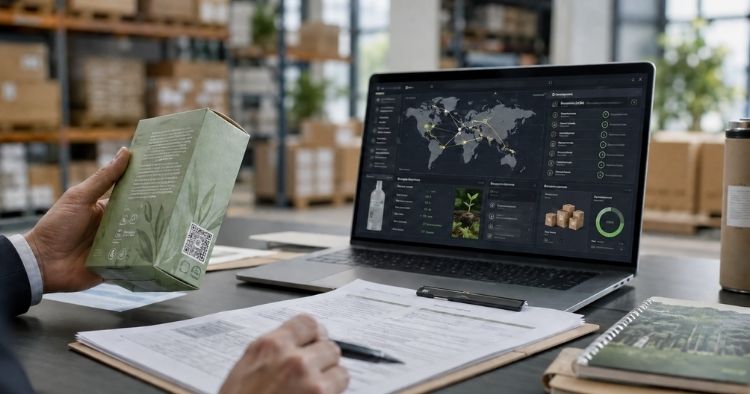
A summary of the contributions by Angeline Camus, Alessandro Chelli, Marcello Valenti, Josil Murray, Alain Rival and Vincenzo Tapella on the sustainable palm oil supply chain.
The sustainable palm oil supply chain is entering a new phase: the voluntary tools developed over the years are now being complemented by the requirements introduced by the European Union Deforestation Regulation. This was the central theme of the webinar “From voluntary sustainability to EUDR compliance and beyond: evolution and perspectives of the sustainable palm oil supply chain”, organised by the Italian Union for Sustainable Palm Oil, Roundtable on Sustainable Palm Oil – RSPO and Trusty as part of the Sustainable Development Festival 2026 promoted by ASviS.
The meeting was moderated by Francesca Ronca, Secretary General of the Italian Union for Sustainable Palm Oil, who guided the discussion among companies, industry organisations, the research community and technology partners on a key challenge for the supply chain: integrating the progress made over the years on certification, traceability and sustainability with the new European obligations, while also looking at initiatives that go beyond regulatory compliance.
Angeline Camus: a supply chain already prepared for the EUDR challenge
The first point that emerged from the discussion concerns the value already built by the sustainable palm oil supply chain. Voluntary standards, certifications, traceability, deforestation monitoring and stakeholder engagement have created a knowledge base that is now particularly relevant for addressing the EUDR.
This was the focus of the contribution by Angeline Camus, Government Affairs Manager Europe at the Roundtable on Sustainable Palm Oil – RSPO, who highlighted the role of voluntary standards in supporting more transparent and responsible supply chains. With more than twenty years of activity, RSPO certifies around 20% of the palm oil produced globally; in Europe, almost 90% of imported palm oil is RSPO-certified, with Italy playing a significant role as the third European country by number of member companies.
The RSPO standard was not presented as an alternative to the European regulatory framework, but as a supporting tool to be integrated with the Regulation’s requirements. In this context, PRISMA, the platform developed by RSPO, plays an important role in making the information collected along the supply chain more accessible and usable, supporting not only EUDR compliance but also ESG reporting and broader global sustainability needs.
Alessandro Chelli: making EUDR compliance operational
The contribution by Alessandro Chelli, CEO and Co-Founder of Trusty, shifted the focus to the operational implications of the EUDR for companies.
The Regulation requires companies to organise processes capable of managing geographic data, documentation, supplier information, risk assessment and connection with the European Information System. It is therefore not simply a formal requirement, but a process that calls for method, reliable digital tools and coordination among the different actors in the supply chain.
Among the key aspects addressed, Chelli highlighted the role of geolocation, data quality, document management and interoperability. These elements directly affect a company’s ability to prepare due diligence statements that are consistent, verifiable and sustainable over time.
Particular attention was also given to preparatory activities and operational testing, including dry-run experiences. These exercises make it possible to test information flows in advance, identify technical issues, assess digital tools and better understand how to organise processes before the obligations fully enter into force.
However, these tests should not be confused with a prior validation of compliance. Their value is mainly practical: they help companies prepare, improve data quality and strengthen internal procedures.
During the session, several interpretative and technical issues of particular relevance to companies were also discussed, including the role of downstream operators, the management of information along the supply chain, the scope of legality requirements, the full operability of the European Information System and the need for greater harmonisation in the application of the rules.
The underlying message is clear: the EUDR requires practical solutions, technical support, interoperability, multi-stakeholder collaboration and greater interpretative clarity. Only in this way can compliance become a truly manageable process, integrated into companies’ day-to-day operations.
Marcello Valenti: Unigrà’s experience across supply chain, data and ESG
The company perspective was provided by Marcello Valenti, Sustainability Manager at Unigrà, who showed how the EUDR fits into sustainability and control processes that many companies have already started.
In Unigrà’s case, this work includes RSPO certification, dialogue with suppliers and participation in sector initiatives dedicated to risk assessment. Among the most concrete elements mentioned, Valenti highlighted the achievement of 100% traceability to mills and the use of satellite monitoring tools, including Satelligence, to verify sourcing areas against EUDR requirements.
The contribution also highlighted the link between EUDR compliance and climate reporting. Unigrà’s work on measuring greenhouse gas emissions along the supply chain, with reference to Scope 3 emissions connected to land use and the collaboration with xFarm, shows how the quality of supply chain data can support both regulatory obligations and stronger ESG strategies.
Josil Murray: EUDR Community of Practice and technical dialogue
The implementation of the EUDR does not concern individual companies alone. It requires dialogue, coordination and shared learning. This was the perspective brought by Josil Murray, from the European Forest Institute – EFI, who focused on the EUDR Community of Practice.
The Community of Practice was presented as a neutral technical space for discussion among companies, competent authorities, NGOs, technical experts and institutions. Created to encourage operational dialogue after the postponement of the EUDR, the initiative has grown rapidly, moving from around 270 participants at launch to more than 1,100 subscribers.
The webinar also highlighted the value of the dry-runs facilitated by the European Forest Institute – EFI, particularly those related to palm oil in Indonesia and Malaysia. These experiences make it possible to test due diligence systems, data quality and risk assessment approaches, encouraging a more concrete dialogue between companies and competent authorities.
Alain Rival: the TRAILS project and regenerative approaches
The final part of the discussion broadened the perspective to initiatives that go beyond regulatory compliance. Alain Rival, from CIRAD – Centre de coopération internationale en recherche agronomique pour le développement, presented the TRAILS project, dedicated to agroforestry and landscape approaches in oil palm cultivation.
Developed in Malaysia, the project tests, under real-life conditions, the integration of oil palm with 15 native forest species, with the aim of strengthening biodiversity, improving the resilience of agricultural systems, supporting climate adaptation and assessing production models that are more integrated into the landscape.
The message is clear: compliance is essential, but it cannot be considered the final goal. The sustainability of agricultural supply chains also requires the ability to reduce impacts, restore ecosystems, support local communities and develop science-based regenerative approaches.
Vincenzo Tapella: a shared perspective for the supply chain
In his closing remarks, Vincenzo Tapella, President of the Italian Union for Sustainable Palm Oil, underlined the value of a shared, long-term vision. The EUDR represents an important milestone, but it is part of a journey already underway through voluntary standards, traceability systems, collaborative initiatives and monitoring tools.
For the sustainable palm oil supply chain, the new Regulation is a significant challenge, but also an opportunity to build on the work already done and further strengthen transparency, responsibility and the capacity for transformation.
Watch the webinar
To explore the topics discussed during the webinar “From voluntary sustainability to EUDR compliance and beyond: evolution and perspectives of the sustainable palm oil supply chain” and access the slides, visit the dedicated page: https://www.oliodipalmasostenibile.it/dalla-sostenibilita-volontaria-alla-compliance-eudr-olio-di-palma-sostenibile/