Recent EUDR updates have changed the application timeline and clarified several operational aspects of the Regulation. Yet many companies still find it difficult to navigate the postponements, new deadlines, simplifications and steps needed to prepare for the obligations coming into force.
This article brings together the most relevant updates, with a practical focus on what companies need to know to approach EUDR compliance in a gradual and structured way.
Regulation (EU) 2023/1115 has a clear goal: to prevent commodities and derived products linked to deforestation or forest degradation from entering, circulating within, or being exported from the EU market unless they meet the required conditions.
The core principle has not changed. Cattle, cocoa, coffee, oil palm, rubber, soy, wood and the derived products listed in Annex I can only circulate if they are deforestation-free, produced in line with the relevant laws of the country of production, and covered by a due diligence statement or, where applicable, a simplified declaration.
With Regulation (EU) 2025/2650, Version 5 of the European Commission’s FAQ and the updated supply chain infographics, the application framework has been partly simplified and clarified. The main updates concern deadlines, supply chain roles, geolocation, products already covered by a declaration, reference numbers, micro and small primary operators, and substantiated concerns.
1. The new EUDR deadlines
The application of the substantive obligations has been postponed by 12 months. The key new deadlines are 30 December 2026 and 30 June 2027.
The reference date: 31 December 2024

31 December 2024 is the reference date used to determine which deadline applies. Operators that qualified as micro or small enterprises based on their 2024 financial statements benefit from the 30 June 2027 deadline. All other companies must comply by 30 December 2026. Any later changes in company size do not affect the applicable deadline.
The transitional regime for the Timber Regulation
Timber is subject to a specific transitional rule linked to the production date of the raw material.
The previous Timber Regulation (EUTR, Regulation (EU) No 995/2010) will continue to apply until 31 December 2029 to timber and timber products manufactured before 29 June 2023 and placed on the market from 30 December 2026 onwards. After that date, these products will also fall fully under the EUDR.
This is a postponement, not an exemption: the obligations still apply, but for a limited period they will continue to follow the EUTR rules. The legal basis is Article 38 of the EUDR, read together with Article 1(2).
Products manufactured from 29 June 2023 onwards do not benefit from any transitional regime. They follow the standard EUDR timeline, with obligations fully applicable from 30 December 2026 for large and medium-sized operators, and from 30 June 2027 for micro and small enterprises.
The key date is therefore the production date of the raw material, not the date the product is placed on the market.
The postponement gives companies more time, but it does not make compliance any simpler. This period should be used to set up data, processes, and internal responsibilities before the obligations fully come into force.
2. The starting point: understanding your role in the supply chain
To define EUDR obligations correctly, the first question is not only “Which product do I sell?”, but “What role do I play in the supply chain?”.
The same company may be an operator in one commercial flow, a downstream operator in another, and a trader in another. This means the classification must be assessed for each product, transaction and position in the supply chain.
Operator, downstream operator and trader
An operator is the party that places a relevant product on the EU market for the first time, or exports it, when that product is not yet covered by a declaration. This category includes importers, EU producers and exporters of products not yet covered by a declaration. These parties carry the main obligations: carrying out due diligence, submitting the declaration in the information system, taking responsibility for compliance and keeping the required evidence.
A downstream operator is a party that places on the market or exports a relevant product made using products that are already covered by a due diligence statement or a simplified declaration. This applies, for example, to companies that turn wood already covered by a declaration into furniture, or cocoa already covered by a declaration into chocolate.
A trader is any party, other than an operator or downstream operator, that makes available on the market a relevant product that has already been placed on the EU market.
Micro or small primary operator
A micro or small primary operator is a subcategory of operator. It refers to natural persons, microenterprises or small enterprises established in countries classified as low risk, which place on the market or export relevant products they have produced themselves. Instead of submitting a standard due diligence statement, these parties submit a one-off simplified declaration.
First downstream party and subsequent parties
The position in the supply chain also matters. The first downstream operator or trader that receives the product directly from the operator must collect and keep the reference numbers of the declarations or the identifiers of the simplified declarations. Subsequent parties must instead keep basic information on their direct business partners.
3. Relevant products, Annex I and traceability
The EUDR does not automatically apply to every product containing a relevant commodity. It only applies to the products listed in Annex I.
Check products and customs codes
A product that is not listed remains outside the scope of the Regulation, even if it contains, for example, cocoa, palm oil, rubber or wood. The FAQ mention the example of margarine made with palm oil: if it is not included in Annex I, it is not subject to EUDR obligations.
This is why it is essential to map Harmonized System and Combined Nomenclature codes correctly, together with product descriptions. Particular attention should be paid to codes preceded by “ex”: in these cases, only the products expressly described in the Annex are subject to the Regulation.
Collect and validate geolocation data
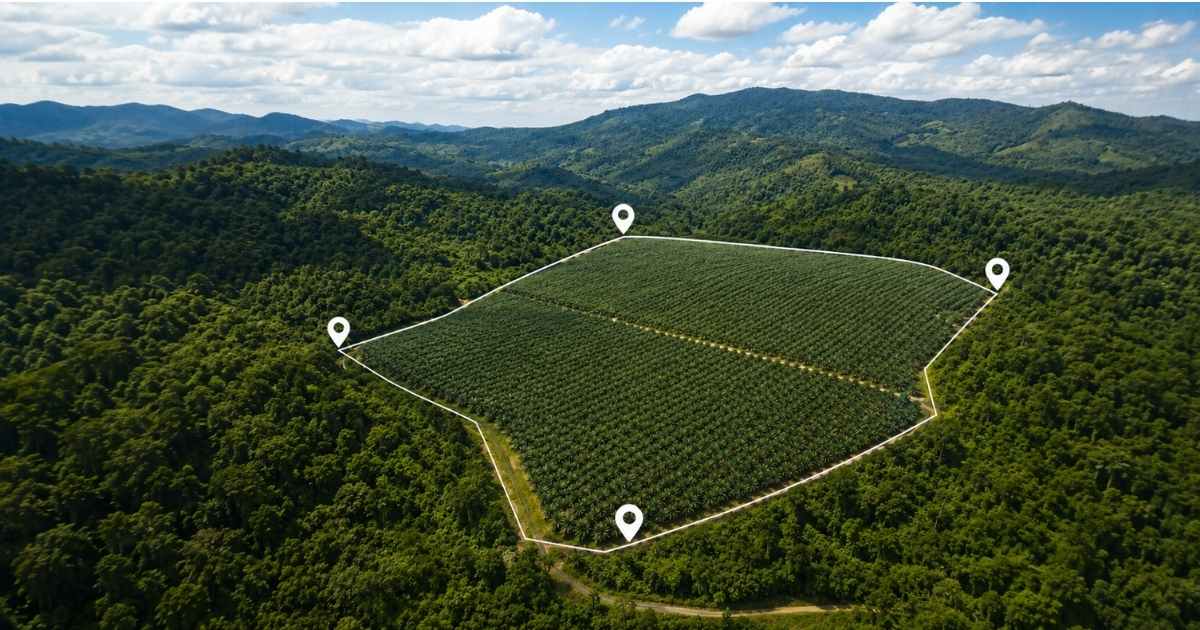
Once a product has been confirmed as in scope, the key issue becomes traceability back to the place of production. Operators must collect the geographic coordinates of the plots where the relevant commodities were produced and include them in the due diligence statement.
For plots larger than 4 hectares, polygons are required, except in the case of cattle. For plots under 4 hectares, either a latitude and longitude point or a polygon may be used. For establishments where cattle are kept, a single point is sufficient.
Data may be collected through producers, cooperatives, intermediaries or certification bodies, but the operator remains responsible for its accuracy. For micro or small primary operators, geolocation may be replaced by the postal address of the plot or establishment, provided it clearly corresponds to the place of production.
4. Products already covered by a declaration, reference numbers and processing cases
One of the main simplifications concerns downstream operators. In general, companies working with products that are already covered by a due diligence statement or a simplified declaration are not required to repeat due diligence or submit a new declaration.
Reference numbers and verification numbers
The obligations focus on document traceability. Downstream operators and non-SME traders must register in the information system. The first downstream operator or trader must collect and keep the reference number of the due diligence statement or the identifier of the simplified declaration received from the supplier.
The FAQ also clarify that a downstream operator or trader is not required to proactively investigate whether its supplier is an operator. If it acts in good faith and does not receive a reference number or identifier, it may assume that the supplier is not required to provide one, unless there are indications to the contrary.
The verification number should not be shared automatically with customers. It is an additional security code, to be used only in specific cases, for example when a non-SME downstream operator, in the presence of a substantiated concern, asks its direct supplier to verify the due diligence.
Dual role and export
An important clarification concerns dual roles. The same company may import a relevant commodity and process it internally. In this case, it may act as an operator at the time of import and as the first downstream operator when selling the processed product.
FAQ 3.8 clarifies that the reference number of the import declaration does not need to be passed on to the downstream customer, because the collection obligation has already been fulfilled internally.
The situation is different when a company uses a commodity it has grown or produced itself, rather than imported, and processes it into a derived product. In this case, the company acts as an operator for the derived product and passes on to the customer the reference number of the declaration relating to the domestic commodity.
A simplification also applies to the export of processed products. When a party exports a product made from goods that have already been placed on the EU market and are already covered by a declaration, it qualifies as a downstream operator for export purposes and does not need to provide customs with a reference number or declaration identifier. In these cases, it may use a dedicated TARIC code, a customs code linked to the Integrated Tariff of the European Union, to indicate that this simplification applies
5. Operational complexities that should not be underestimated
Some FAQ clarifications concern specific cases, but they are highly relevant for agri-food and forestry supply chains.

Bulk commodities, mixing and composite products
For soy, palm oil, cocoa, coffee and other commodities that are stored and mixed, the operator must identify all the plots that may have contributed to the batch intended for the EU market. Mixing with products of unknown origin or non-compliant products is not allowed.
When commodities are stored in silos or tanks that are not emptied regularly, quantities previously entered into the storage system must also be considered, as they may become part of the batch intended for the EU market. The FAQ indicate that, for storage systems such as silos or tanks, it is possible to declare the geolocations of all goods previously introduced until at least 200% of the silo capacity is covered, provided the system operates on a “first in, first out” basis or an equivalent method.
Mass balance traceability systems are not allowed if they involve mixing deforestation-free products with products of unknown origin or non-compliant products.
For composite products, due diligence focuses on the relevant commodity listed in the left-hand column of Annex I. For a chocolate bar classified under code 1806, for example, the relevant commodity is cocoa.
Substantiated concerns and specific cases
A second key issue concerns substantiated concerns: well-founded, reasoned and verifiable information indicating possible non-compliance. This information may be brought to the attention of competent authorities, but also directly to an operator, downstream operator or trader. It is therefore useful to have procedures in place to receive, assess and manage any reports.
The FAQ also clarify specific aspects of the cattle supply chain. The first party placing cattle on the market, whether live or processed, is an operator. A party that keeps the same Combined Nomenclature code in subsequent steps is a trader. A party that processes cattle into derived products is a downstream operator.
For feed, geolocation is not required as such. However, documentary evidence is needed when the feed is itself a relevant product under the EUDR, such as soy flour classified under code 1208 10.
7. Trusty for EUDR compliance
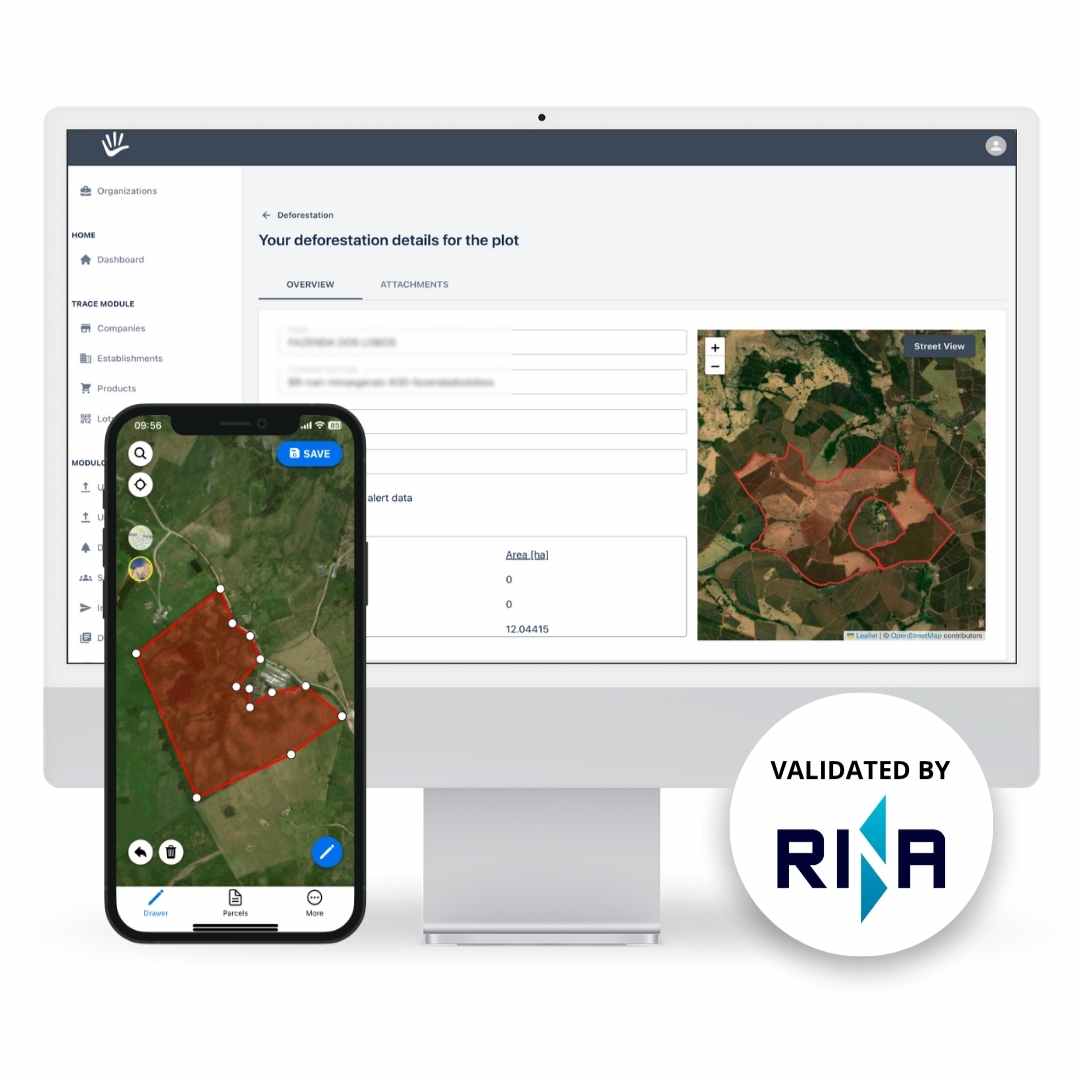
EUDR compliance requires a system that can connect supply chain information, geolocation data, risk assessments, documentary evidence and due diligence statements in a clear and structured way.
Trusty’s platform, validated by RINA, an internationally accredited certification body, was developed to digitalize this process and support companies in the operational management of EUDR obligations. Through a collaborative environment, suppliers and supply chain actors can contribute to data collection, while the EUDR Coordinates Collect app makes it possible to collect coordinates and polygons directly in the field.
The Trusty system supports the automatic validation of uploaded information, flags potential anomalies and enables companies to analyze sourcing areas against deforestation risks. The evidence collected is organized in a structured way, making it easier to prepare Due Diligence Statements, export geolocation data and integrate via API with the EU TRACES NT portal for declaration submission.
In this way, Trusty turns EUDR compliance into a digital, traceable and verifiable process, reducing information fragmentation and improving control across the supply chain.
Contact us to discover how to manage EUDR compliance with Trusty through an integrated workflow between the platform and the EU TRACES NT portal.
Note. Some graphic elements and visual content on this page may include assets licensed from third-party platforms and/or content generated or reworked using artificial intelligence tools. These elements are used within the limits of the relevant licences and for illustrative purposes.